
Responsive vs Adaptive Web Design – Which Is Best for Your Business?
- May 30, 2026
- hor
- 1:41 pm
- No Comments
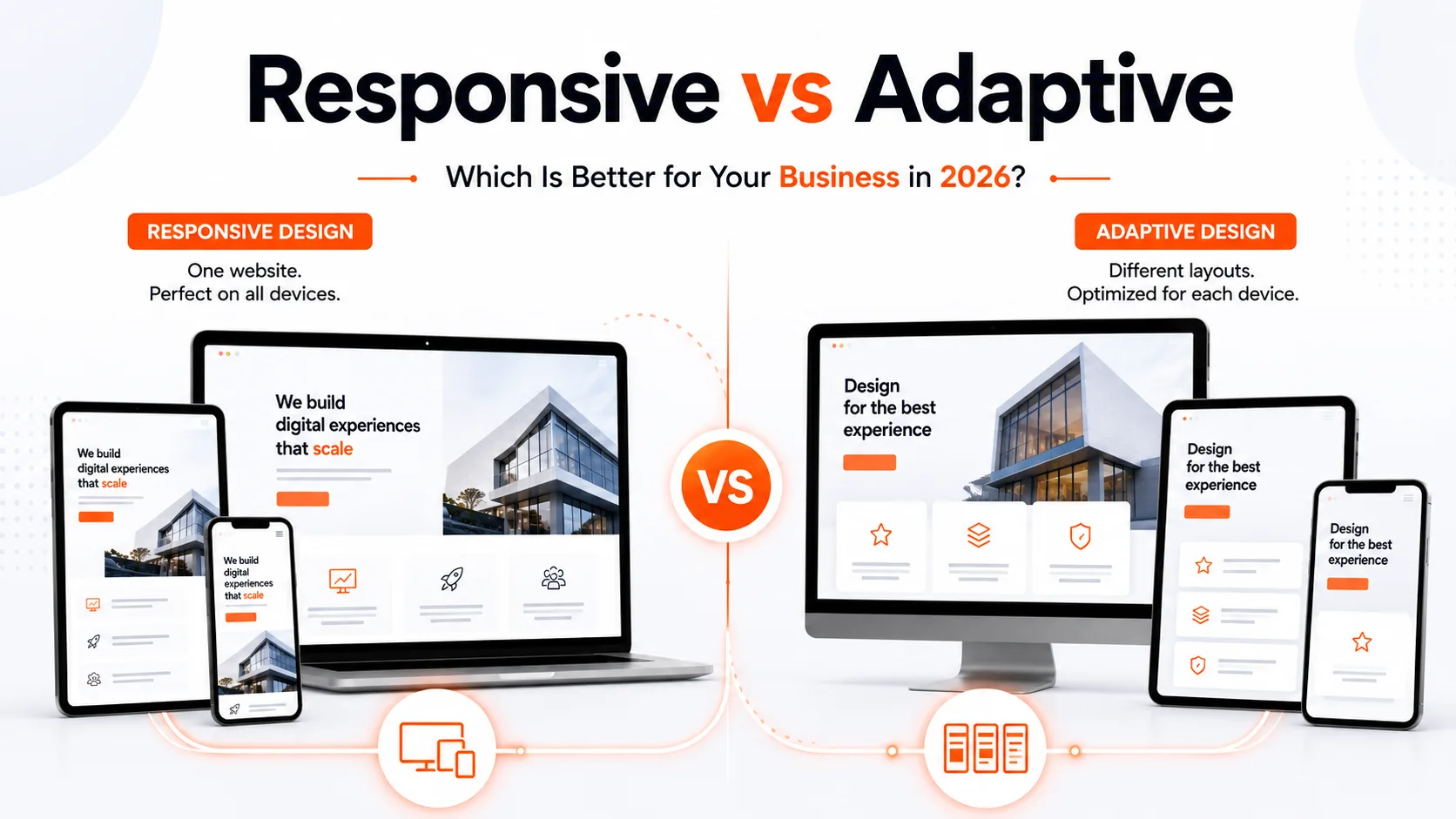
Responsive vs Adaptive Web Design
If you’re planning a website in 2026, chances are someone has already told you this:
“Your site must work on every device.”
That part is true.
What usually gets confusing is how to make that happen.
Choosing between responsive vs adaptive web design is one of the most important decisions for any UK business building or redesigning a website. Both approaches solve device compatibility — but they work differently, cost differently, and suit different goals. Understanding responsive vs adaptive web design helps you brief any web design agency UK with confidence.
Need a website that works properly on every device?
Whether you need a new website, redesign, or performance improvements, we focus on practical solutions that improve usability, rankings, and conversions.
Why this decision actually matters
A website is no longer just about looking good.
It affects how long people stay, whether they trust you, and if they contact or buy from you.
In the UK, most visitors now come from mobile devices. At the same time, desktops haven’t disappeared. Tablets, large monitors, and hybrid devices are also common.
Your design approach decides:
- • How fast your site loads.
- • How easy it feels to use
- • How Google sees your site.
- • How much future changes will cost you.
That’s why choosing between responsive web design UK standards and adaptive website setups is not a small decision. When evaluating responsive vs adaptive web design, understanding these factors helps your website deliver ROI.
What responsive web design really means
Responsive web design is simple in concept.
You build one website, and it adjusts itself based on screen size.
The layout stretches, shrinks, and rearranges automatically. Text stacks differently on mobile. Images resize. Menus collapse. But the content stays the same.
Most modern UK business websites use this approach, even if the owner doesn’t know the term. This is the most common outcome when people search for responsive vs adaptive web design guidance.
Why responsive design became the default
Responsive design didn’t become popular because it was trendy. It became popular because it solved real problems.
- • One website instead of many versions
- • Easier updates
- • Better SEO structure
- • Works smoothly across devices
- • Lower long-term cost.
For responsive web design UK, Google’s mobile-first indexing also played a big role. Google now checks the mobile version first, and responsive sites handle this naturally. Therefore, a responsive website is most important for ranking on Google and other search engines.
What adaptive web design actually does
Adaptive web design takes a different route.
Instead of one flexible layout, you create separate layouts for specific screen sizes. The website detects the device and loads the layout made for that device.
For example:
- • Desktop layout
- • Tablet layout
- • Mobile layout
Each version can be customised differently.
In adaptive website 2026 projects, this approach is usually chosen for performance control or highly specific user journeys.
The main difference (without tech talk)
Here’s the easiest way to understand it:
- • Responsive = one flexible design that adapts
- • Adaptive = multiple fixed designs that switch
Responsive feels fluid.
Adaptive feels controlled.
Neither is “better” by default.
Responsive web design UK: why most businesses choose it
In the UK market, responsive design works well for most industries — services, local businesses, consultants, agencies, and even many online stores.
Practical advantages
- • One website to manage
- • Easier SEO optimisation
- • Lower design and development cost
- • Easier content updates
- • Fewer technical risks
For growing businesses, responsive web design UK solutions keep things simple without limiting growth.
Where adaptive websites make sense in 2026
Adaptive design is not outdated. It’s just more selective.
Businesses that often choose adaptive website 2026 setups include:
- • High-traffic eCommerce brands
- • Platforms where speed is critical
- • Brands with mobile-only or desktop-heavy users
- • Businesses needing device-specific layouts
Adaptive design allows developers to fine-tune each version. That can mean faster load times and more control — but it also means more work.
SEO comparison: responsive vs adaptive
SEO is where many businesses make a common mistake.
Google clearly prefers responsive websites because:
- • One URL for all devices
- • No duplicate content risk
- • Easier crawling and indexing
Adaptive websites can rank well too, but only if:
- • Device detection works perfectly
- • Content stays consistent
- • Technical setup is clean
For most UK businesses, responsive web design UK is simply safer from an SEO point of view.
User experience: what visitors actually feel
Users don’t care about design terminology.
They care about ease.
Responsive design gives consistency.
Adaptive design gives precision.
If your visitors use many different devices, responsive works better.
If most users come from one main device, adaptive can be useful.
In 2026, attention spans are short. If a site feels slow or awkward, users leave. Design choice directly affects this.
Cost difference in real terms
Website design cost matters, especially for small and mid-sized businesses.
Responsive design costs less because:
- • One layout
- • Faster development
- • Less testing
- • Easier maintenance
Adaptive design costs more because:
- • Multiple layouts
- • More testing
- • Higher maintenance
- • More complex updates
That’s why responsive web design UK remains the practical choice for most companies.
Future-proofing your website
Another thing to think about is the future.
New screen sizes appear regularly. Foldables, ultra-wide screens, and hybrid devices are becoming common.
Responsive design handles this naturally.
Adaptive design may require new layouts later.
For businesses planning long-term growth, this matters.
How we usually advise clients at HighOnRank
At HighOnRank, most clients initially ask for “advanced” solutions. After discussion, many realise they don’t need complexity.
In many cases:
- • Responsive design solves the problem
- • Adaptive design is unnecessary
- • Budget is better spent on content, SEO, or performance
We don’t push trends. We focus on what actually works for the business.
Call Us Anytime
+91 96540 78140 | +91 96674 82591
So, which one should you choose?
Choose responsive web design if:
- • You want flexibility
- • You want SEO simplicity
- • You want lower costs
- • You serve a wide audience
Choose adaptive design if:
- • Performance control is critical
- • You have clear device-based users
- • You have the budget to maintain it
- • You need precise layouts
Many businesses start with responsive and move to adaptive only if required.
Final thoughts
Responsive vs adaptive web design is not a competition. It’s a choice based on needs, budget, and future plans.
For most UK businesses, responsive web design remains the smart, stable option. Adaptive design works best when there is a clear reason behind it.
If you’re unsure, the worst move is choosing blindly.
Still unsure whether responsive or adaptive design is right for your business?
Our team can review your current website and recommend the best approach based on your goals, users, and budget.
Frequently Asked Questions About Responsive vs Adaptive Web Design
No, but it is strongly recommended for SEO and usability.
Yes, if the technical setup is done correctly.
Responsive web design usually costs less.
No, it’s still useful for specific needs.
Responsive web design is usually the better choice.
Need honest advice?
If you’re planning a website or redesign and want clarity, HighOnRank can help.
We focus on real-world solutions, not buzzwords.
Success Story
A Coffee Company Zora Hughes contacted us because their website zorahughes.com was not helping the business. The design looked old and did not match the brand anymore. On mobile phones, the site was difficult to use, and people were not staying for long.
We started with the website design. The old layout was removed, and a new structure was created. The focus was simple pages, clear navigation, and proper mobile support. After the redesign, the website opened correctly on all screen sizes and felt easier to use.
Once the new website was live, we moved to SEO. We worked on page content, fixed basic technical problems, and organised the site so search engines could understand it better. There was no shortcut work done.
After some time, the website started getting better visibility. Visitors stayed longer and enquiry requests became more regular. The new design and SEO work together helped Zorahughes.com improve its online presence.